Steel Grating Types, Applications and Selection Guide
Steel grating is a widely used metal flooring and covering solution for industrial, commercial, and infrastructure projects. Depending on the manufacturing method, bearing bar design, application, and surface treatment, steel grating can be supplied in many different styles.
Choosing the right type of steel grating is important to ensure sufficient load capacity, slip resistance, durability, and cost-effectiveness.
This guide introduces the main steel grating types, their applications, and key factors to consider when selecting the right product for your project.
1. Steel Grating Types by Manufacturing Method
Press-Welded Steel Grating
Press-welded steel grating is the most commonly used type of steel grating. It offers excellent load-bearing performance, versatility, and cost-effectiveness.
The bearing bars and cross bars are welded together under high pressure, creating a strong and stable grating structure.
Typical applications include:
- Industrial platforms
- Walkways and access platforms
- Drainage trench covers
- Solar PV maintenance platforms
- Factory floors and work platforms
For most standard industrial applications, press-welded steel grating is a practical and economical choice.
Press-Locked Steel Grating
Press-locked steel grating, also known as swage-locked or press-locked grating, is manufactured by mechanically locking the cross bars into the bearing bars without conventional welding.
It provides a clean and uniform appearance, high structural strength, and a smooth surface. It is particularly suitable for projects where appearance, structural integrity, or corrosion resistance is important.
Typical applications include:
- Heavy-duty platforms
- Architectural projects
- Industrial facilities
- Areas with high aesthetic requirements
- Applications requiring additional corrosion resistance
Composite Steel Grating
Composite steel grating combines a steel grating panel with a solid surface plate. The top plate helps prevent small objects, debris, and materials from falling through the grating.
This design is especially useful for elevated platforms and areas where objects need to be contained.
Typical applications include:
- Elevated platforms
- Industrial maintenance platforms
- Cleanrooms
- Stair treads
- Areas requiring a more enclosed walking surface
2. Steel Grating Types by Bearing Bar Design
The shape and surface of the bearing bars directly affect the load capacity, slip resistance, weight, and overall performance of steel grating.
Plain Bearing Bar
Plain bearing bars feature a flat, smooth surface and are the standard choice for general applications.
They are economical and provide reliable load-bearing performance under normal conditions.
Suitable for:
- Dry indoor areas
- Standard industrial platforms
- Factory walkways
- General access areas
Serrated Bearing Bar
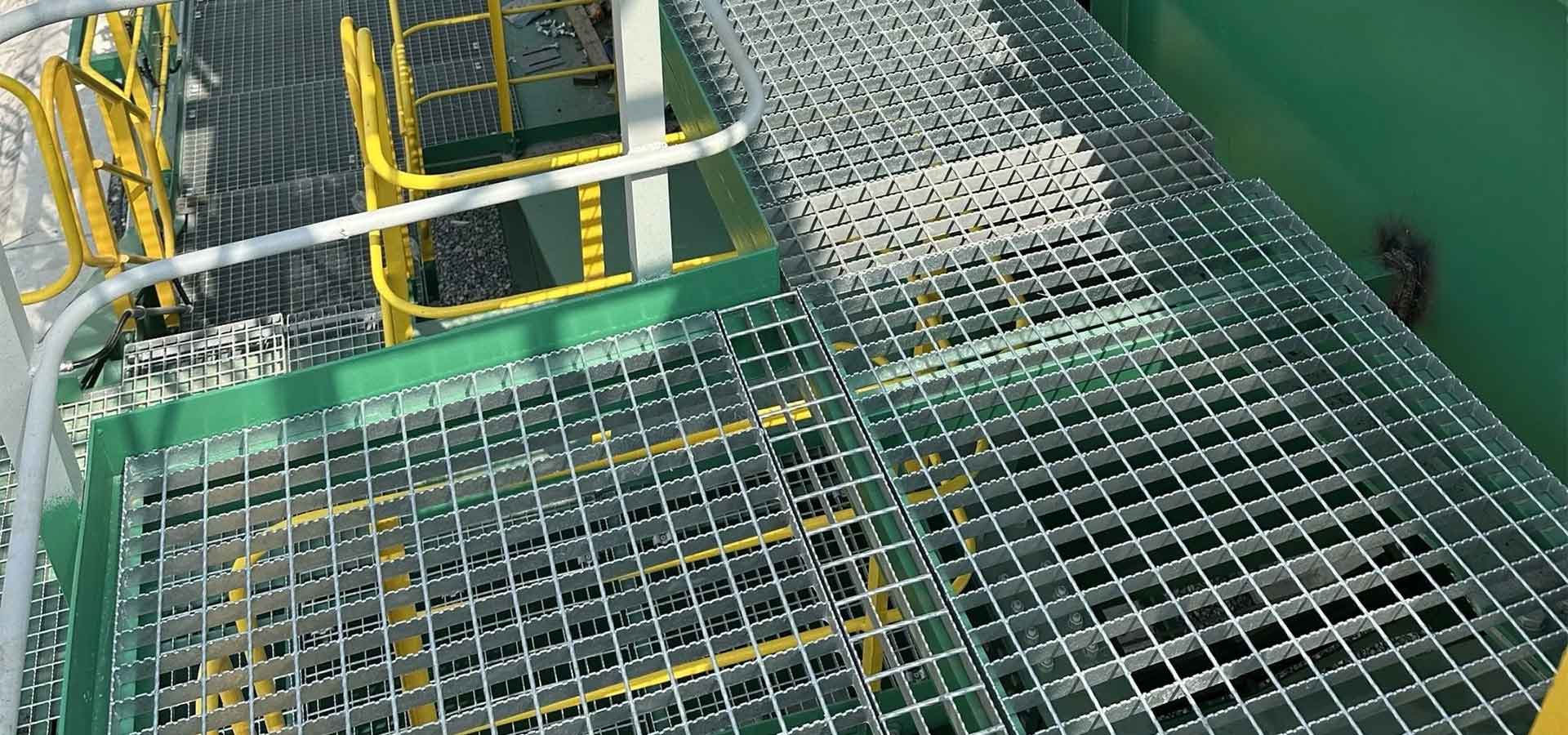
Serrated steel grating has serrations or teeth along the surface of the bearing bars, providing significantly improved slip resistance.
It is an excellent choice for environments exposed to water, oil, snow, or other slippery conditions.
Suitable for:
- Wet areas
- Oil-contaminated environments
- Outdoor walkways
- Sloped platforms
- Marine and offshore platforms
- Areas requiring enhanced slip resistance
For safety-critical applications, serrated steel grating can provide an important additional level of protection against slipping.
I-Bar Bearing Bar
I-bar grating uses I-shaped bearing bars instead of conventional flat bars. This design can reduce the weight of the grating while maintaining good load-bearing capacity.
It is particularly suitable when engineers need to achieve high strength with reduced structural weight.
Suitable for:
- Long-span platforms
- Heavy-load applications
- Large industrial platforms
- Lightweight structural designs
3. Steel Grating for Specific Applications
In addition to standard grating panels, various specialized steel grating products are available for different applications.
Stair Treads
Steel grating stair treads are specially designed for industrial and outdoor staircases. They can be supplied in different standard configurations, including T1, T2, T3, and T4, depending on the supporting structure and installation requirements.
Typical applications include:
- Steel staircases
- Maintenance ladders
- Industrial stairs
- Outdoor stairs
- Fire escape stairs
Stair treads can also be supplied with nosing to improve visibility and slip resistance.
Trench Grating and Drain Covers
Steel trench covers are designed to cover drainage channels while allowing water and other liquids to pass through.
Depending on project requirements, trench grating can be supplied with frames, removable designs, or anti-theft features.
Typical applications include:
- Industrial drainage trenches
- Factory floors
- Municipal drainage systems
- Roads and sidewalks
- Plant facilities
Close-Mesh Steel Grating
Close-mesh steel grating uses smaller openings between the bearing bars and cross bars. This helps prevent tools, small components, and other objects from falling through the grating.
Typical applications include:
- Elevated walkways
- Maintenance platforms
- High-level working areas
- Areas with heavy pedestrian traffic
- Locations where small-object protection is required
Custom-Shaped Steel Grating
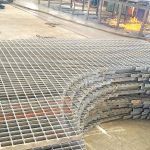
Steel grating does not always need to be rectangular. Custom grating panels can be manufactured in various shapes, including fan-shaped, circular, curved, and polygonal designs.
Custom-shaped grating is particularly useful when standard rectangular panels cannot fit the project layout.
Typical applications include:
- Around industrial equipment
- Circular platforms
- Tanks and vessels
- Curved walkways
- Irregular or customized structures
4. Steel Grating Surface Treatments
Surface treatment is another important factor when selecting steel grating. The appropriate finish depends mainly on the installation environment, corrosion exposure, service life, and budget.
Hot-Dip Galvanized Steel Grating
Hot-dip galvanizing provides excellent corrosion protection and is one of the most widely used finishes for outdoor steel grating.
It is particularly suitable for environments exposed to rain, moisture, and outdoor weather conditions.
Recommended for:
- Outdoor platforms
- Walkways
- Drain covers
- Industrial facilities
- Solar PV platforms
- Marine and coastal environments
Electro-Galvanized Steel Grating
Electro-galvanizing provides a thinner zinc coating compared with hot-dip galvanizing. It offers basic corrosion protection at a relatively low cost.
It is generally more suitable for indoor or less demanding environments.
Painted or Black Steel Grating
Painted or untreated black steel grating is an economical option for applications where extreme corrosion resistance is not required.
It is commonly used for indoor projects or applications where the grating will receive additional protective coating after installation.
Stainless Steel Grating
Stainless steel grating, commonly manufactured from 304 or 316 stainless steel, offers excellent corrosion resistance and long-term durability.
It is particularly suitable for aggressive or hygienically sensitive environments.
Typical applications include:
- Chemical plants
- Food processing facilities
- Pharmaceutical facilities
- Marine environments
- Coastal installations
- Areas exposed to corrosive chemicals
How to Choose the Right Steel Grating?
Selecting the right steel grating should be based on more than appearance or price. Consider the following factors:
1. Load requirements
Determine the expected pedestrian, equipment, vehicle, or concentrated load.
2. Span and support conditions
The distance between supports affects the required bearing bar size and grating specification.
3. Slip resistance
For wet, oily, snowy, or sloped areas, serrated bearing bars are generally a better choice.
4. Installation environment
Indoor and outdoor applications may require different surface treatments. For outdoor applications, hot-dip galvanized steel grating is often preferred.
5. Opening size
If small objects must not fall through the grating, close-mesh or composite grating may be more appropriate.
6. Shape and dimensions
For irregular structures, custom-cut or custom-shaped steel grating can provide a better fit and reduce installation difficulties.
7. Corrosion resistance
For highly corrosive environments, hot-dip galvanized steel or stainless steel grating may be required depending on the project conditions.
Custom Steel Grating for Your Project
There is no single steel grating solution suitable for every project. The right combination of bearing bar size, cross bar spacing, grating type, surface treatment, dimensions, and load capacity should be selected according to the actual application.
As a professional steel grating manufacturer, we provide standard and custom steel grating solutions for industrial platforms, walkways, stair treads, trench covers, solar PV platforms, and other applications.
If you have a specific project or are unsure which steel grating type is suitable for your application, feel free to contact us. Our team can help you select the appropriate grating specification based on your load requirements, installation environment, dimensions, and project conditions.